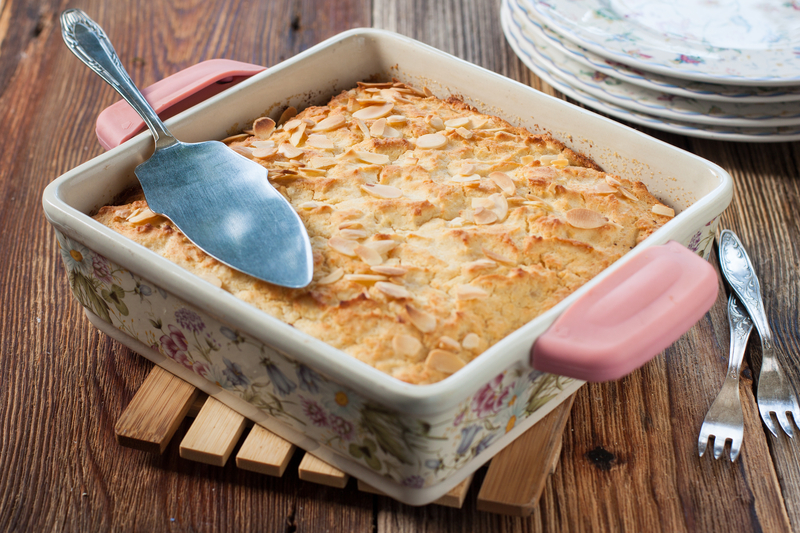


If you have an 8×8 pan sitting in your kitchen, you might wonder exactly how much it can hold before you start a new recipe.
A standard 8×8 pan with 2-inch sides holds about 2 quarts, but the exact pan capacity depends on how deep your specific pan is.
This small detail matters more than you might think when you’re following a recipe that calls for a specific size.
Baking pan sizes can be confusing because two pans that look similar on the outside might hold different amounts inside. A quart measurement gives you a clear way to compare pans and figure out if a swap will work for your recipe. Knowing this number helps you avoid a pan that overflows or a dish that turns out too thin.
This guide breaks down how to check your own pan’s capacity, what affects the quart measurement, and what to do if your pan doesn’t match the standard 2-quart size. You’ll walk away knowing exactly how to measure your pan and choose the right one for whatever you’re making.
The Short Answer: Capacity Depends on Pan Depth
 An 8×8-inch baking pan holds about 1.5 to 2 quarts, depending on how deep the sides are. Most standard pans fall close to 2 quarts, but the exact number changes based on depth, material, and how full you fill the pan.
Typical Capacities for 1.5-Inch and 2-Inch Pans
Your pan’s depth makes a bigger difference than you might think. A pan with 1.5-inch sides holds less than one with 2-inch sides, even though both measure 8×8 inches across the top.
Here’s how the numbers break down:
- 1.5-inch deep pan: holds around 1.5 quarts
- 2-inch deep pan: holds close to 2 quarts
Most 8×8-inch pans you’ll find in stores have 2-inch sides. This makes 2 quarts the most common answer you’ll see on packaging and in recipes.
If your pan has shorter sides, don’t assume it holds the same amount. Check the depth before you follow a recipe that lists volume instead of pan size.
Brim Capacity Versus Usable Volume
Brim capacity means how much your pan holds when filled all the way to the top edge. Usable volume is smaller, because you never actually fill a pan that high.
You need room for batter to rise or liquid to bubble without spilling over. Most bakers fill a pan to about 70-80% of its brim capacity. This means your real usable volume is often closer to 1.5 quarts, even in a pan rated for 2 quarts at the brim.
Think about it this way: a 2-quart pan filled to the brim leaves zero room for expansion. That’s a problem for cakes, brownies, and anything with rising agents like baking soda or baking powder.
Cups, Fluid Ounces, and Liters at a Glance
Quarts aren’t the only way to measure your pan’s capacity. Here’s how the numbers convert:
| Measurement | Approximate Value |
|---|---|
| Quarts | 1.5 to 2 quarts |
| Cups | 6 to 8 cups |
| Fluid ounces | 48 to 64 fl oz |
| Liters | 1.4 to 1.9 liters |
If your recipe uses cups instead of quarts, remember that 8 cups equals 2 quarts. Many U.S. recipes list volume in cups, while some international recipes use liters instead.
Knowing these conversions helps you double-check your pan’s capacity no matter which measurement system your recipe uses.
How to Measure Your Pan’s Actual Capacity
 You can find your pan’s real volume with a simple water test, or by measuring its inside dimensions and doing the math. Both methods work, but each one gives you slightly different results depending on your pan’s shape.
The Water Displacement Test
The water displacement test is the most accurate way to check your pan’s true capacity. Fill the pan with water using a measuring cup, and count how much water it takes to reach the top.
Use a digital scale for even better accuracy. Since water weighs about 1 gram per milliliter at room temperature, you can weigh the water instead of relying on a cup’s markings.
Here’s a quick way to do it:
- Place the empty pan on a scale and set it to zero.
- Pour in water until it reaches the rim.
- Check the weight in grams, then convert to quarts (1 quart equals about 946 grams of water).
This method accounts for the pan’s actual shape, not just its labeled size.
Using Internal Dimensions to Calculate Volume
You can also calculate volume using your pan’s internal dimensions. Measure the length, width, and height inside the pan, not the outer edges, since the walls take up space too.
Multiply length by width by height to get the volume in cubic inches. Then divide that number by 57.75, since that’s how many cubic inches make up one US quart.
For example, an 8×8 pan with 2-inch-tall walls gives you: 8 × 8 × 2 = 128 cubic inches 128 ÷ 57.75 = about 2.2 quarts
This method gives you a close estimate, but it won’t be exact if your pan has curved or angled sides.
Why Rounded Corners and Sloped Sides Matter
Rounded corners and sloped sides can throw off your dimensional calculations. Most pans aren’t perfect boxes. The corner radius on many baking dishes removes some usable space compared to a pan with sharp, square corners.
Sloped sides create a similar issue. If your pan is wider at the top than the bottom, the internal volume will be smaller than a simple length-times-width-times-height formula suggests.
This is why the water displacement test tends to give you more reliable results. It captures the pan’s real shape, including any curves or slants, instead of relying on straight-line measurements that assume a perfect rectangle.
Why Equal Dimensions Do Not Always Mean Equal Volume
 Two pans can both be labeled 8×8 and still hold different amounts of batter. This happens because the label only refers to the top opening, not the actual depth or shape of the inside.
Interior Measurements Versus Exterior Measurements
When you measure a pan from the outside, you get a different number than when you measure the inside. Pan walls add thickness, and that thickness eats into your usable space.
A pan listed as 8×8 on the box might only be 7.75×7.75 inches on the inside. This small gap changes your pan volume more than you’d expect.
Here’s why this matters for baking:
- Sloped walls reduce volume near the top
- Rounded corners lose space compared to sharp corners
- Depth varies even when the top opening looks the same
You should always measure the inside of your pan with a ruler before assuming it matches the size printed on the label.
Material Thickness and Pan Design
Pan material affects wall thickness, and wall thickness affects how much batter fits inside. A stainless steel pan often has thinner walls than a ceramic pan or enameled cast iron pan.
Thicker materials take up more interior room. This means an aluminum pan and a ceramic pan labeled the same size may hold different volumes.
| Pan Material | Typical Wall Thickness | Effect on Volume |
|---|---|---|
| Aluminum pan | Thin | Slightly more interior space |
| Stainless steel | Thin to medium | Close to labeled size |
| Ceramic pan | Thick | Reduced interior space |
| Enameled cast iron | Thick | Reduced interior space |
Nonstick coating adds a small amount of thickness too, though it’s usually minor compared to the base material itself.
Manufacturer Labels and Brand Differences
Bakeware brands don’t follow one universal standard for sizing. Pyrex, USA Pan, and other brands round their dimensions to the nearest common size, even if the true measurement is slightly different.
A USA Pan 8×8 might have a true depth of 2 inches, while a Pyrex glass version could measure 1.75 inches deep. Neither company is wrong, but the labels don’t tell you the full story.
If you’re following a recipe that depends on exact pan volume, check the manufacturer’s product specs. Many brands list volume in quarts or cups directly on their website, which gives you a more reliable number than the pan name alone.
Choosing an Equivalent Pan for an 8×8 Recipe
 An 8×8 pan holds about 2 quarts, so your best substitutes are pans with a similar volume and depth. Some swaps work with almost no changes, while others need you to adjust bake time or watch for spills.
Comparing an 8×8 Pan With a 9×9 Pan
A 9×9 pan is the closest match to an 8×8 pan, but it’s not identical. The 9×9 pan holds about 2.5 quarts, compared to 2 quarts for the 8×8 pan.
That extra space means your batter or filling will spread thinner. Baked goods in a 9×9 pan often finish 3 to 5 minutes faster than the same recipe in an 8×8 pan.
Check your food a few minutes early to avoid overbaking. This swap works well for brownies, bar cookies, and coffee cakes.
If you’re scaling a recipe up, you can increase the batter by about 20% to fill a 9×9 pan the same way it would fill an 8×8 pan.
When a 9-Inch Round Cake Pan Works
A 9-inch round cake pan holds close to 2 quarts, making it a solid stand-in for an 8×8 pan. An 8-inch round cake pan works too, though it holds slightly less volume.
The round shape changes how heat moves through the batter, so edges may bake faster than the center. This matters most for dense cakes or custard-style desserts.
For light batters like sponge cake, the round pan swap is nearly seamless. For thick brownie batter, expect a slightly different texture at the edges.
Round cake pans work best when your recipe doesn’t depend on square corners or straight-edged slices, like bar cookies do.
Using a Loaf Pan or 2-Quart Baking Dish
A standard loaf pan and a 2-quart baking dish both offer volume close to an 8×8 pan, but shape changes the outcome. A loaf pan is narrow and deep, so batter takes longer to bake through the center.
A 2-quart baking dish, often used for casseroles, is a closer physical match if it has a similar square or rectangular shape. Glass and ceramic 2-quart dishes are common for baked pasta, cobblers, and casseroles.
Use this table as a quick reference:
| Pan Type | Approx. Volume | Best For |
|---|---|---|
| Loaf pan | 2 quarts | Bread, dense cakes |
| 2-quart baking dish | 2 quarts | Casseroles, cobblers |
| 8×8 square pan | 2 quarts | Brownies, bars |
Choose the loaf pan for recipes meant to be sliced, and the baking dish for recipes served as scoops.
Why a 9×13 Pan Is Not a Direct Swap
A 9×13 pan holds about 3 quarts, which is 50% more volume than an 8×8 pan. This size difference means your batter will spread thin across a much larger surface area.
Baked goods often turn out flatter and cook faster in a 9×13 pan. Bake time can drop by 25% or more, so check for doneness early.
If you only have a 9×13 pan, you can increase your recipe by about 50% to fill it properly. Otherwise, expect thinner brownies, bars, or cakes with less rise than the recipe intended.
This pan works better as an upsized substitute than a same-size swap for an 8×8 recipe.
Adjusting Baking Time and Results When Substituting
 When you swap pan sizes, your bake time and final texture will change too. The main factors are surface area, batter depth, and the material your pan is made from.
Surface Area, Batter Depth, and Cooking Times
An 8×8 pan has 64 square inches of surface area. If you switch to a pan with more surface area, your batter spreads thinner and bakes faster.
A smaller pan with the same volume means deeper batter, so it needs more time in the oven. This is because of the surface-area-to-volume ratio. More surface area exposed to heat means faster moisture loss and quicker cooking.
Here’s a simple guide:
- More surface area than 8×8: Reduce baking time, check 5-10 minutes early
- Less surface area than 8×8: Increase baking time, add 5-15 minutes
- Same surface area, different shape: Baking time stays close to original
Your ingredient ratios don’t change when you switch pans. Only the depth and shape of the batter change, so plan your time adjustments around that.
How Pan Material Changes Heat Distribution
Pan material affects how heat moves into your batter. Metal pans, especially aluminum, have high material conductivity. They heat up fast and spread that heat evenly across the bottom and sides.
Glass and ceramic pans work differently. They have better heat retention, meaning they hold heat longer once they warm up. This can cause edges to overbake if you don’t lower your oven temperature slightly.
Dark metal pans absorb more heat than light-colored ones. If you’re using a dark pan instead of a light one, drop your baking temperature by about 25 degrees Fahrenheit to avoid burning the edges before the center sets.
Heat transfer speed also affects oven spring, the rise you see in the first few minutes of baking. Faster heat transfer can create a stronger oven spring but risks a drier finished cake if left too long.
When to Check for Doneness
Start checking your cake 5 to 10 minutes before the recipe’s suggested end time. This matters even more when you’ve changed pan sizes, since your original bake time is just an estimate for the original pan.
Look for a few signs instead of relying on the timer alone:
- The cake pulls slightly away from the pan’s sides
- A toothpick or cake tester comes out clean or with a few moist crumbs
- The top springs back when you press it lightly with your finger
If your batter is deeper than usual, check more often near the end. Thick batter can look done on top while staying wet in the middle.
Best Uses for an 8×8 Baking Dish
 An 8×8 pan works well for small desserts, hearty casseroles, and simple meal prep. Its size gives you enough room for everyday cooking without making too much food for one household.
Brownies, Bars, and Small Cakes
An 8×8 pan is a classic choice for brownies and bars. The size gives you thick, evenly baked squares instead of thin ones that dry out too fast.
This pan also works well for fudge and small cakes. Because the dish holds heat evenly, your baked goods cook through without burning on the edges.
If you like thicker desserts, stick with an 8×8 pan instead of a bigger one. A larger pan spreads the batter thin, which can change texture and baking time.
Casseroles and Savory Side Dishes
You can use an 8×8 pan for small casseroles, including lasagna made for two to four people. The dish holds enough layers of pasta, sauce, and cheese without spilling over.
It also works well for apple crisp and other fruit-based bakes. The size fits a modest amount of fruit and topping, so it cooks evenly.
For side dishes, this pan is a good size for baked rice, roasted vegetables, or grain-based bakes. It gives you enough space to cook a full side dish without wasting oven room.
Meal Prep and Portion-Controlled Recipes
An 8×8 pan is useful for meal prep because it holds a set amount of food. This makes it easier to divide meals into equal portions, which helps with portion control and health-conscious cooking.
You can use it to make nutrient-dense casseroles, like a lentil loaf, that you slice into servings for the week. It also works well for baked oatmeal or quinoa bakes that you can portion out for breakfast or lunch.
Since the pan holds about 2 quarts, it’s often enough for 4 to 6 servings, depending on the recipe. This makes it a good size for planning meals ahead without overcooking or wasting food.
Care and Safety for Glass, Ceramic, and Metal Pans
Each type of 8×8 pan needs different care. Glass and ceramic pans can crack from thermal shock, which happens when a cold dish goes straight into a hot oven or touches cold water while still hot.
To avoid this, let glass or ceramic pans come closer to room temperature before baking. Also avoid placing a hot dish on a cold or wet surface.
Metal pans handle heat changes better, but they can react with acidic foods like tomato sauce or citrus-based dishes. This can affect flavor and, in some cases, cause slight metal leaching.
For food safety, always check that casseroles reach a safe internal temperature before serving. Let hot dishes cool slightly before storing them in the fridge to avoid condensation and bacterial growth.
 An 8×8-inch baking pan is a common size for brownies, cakes, casseroles, and other baked dishes. Its capacity is often confused with a 2-quart baking dish, but the two sizes are not exactly the same.


