Should Baked Potatoes Be Cooked on High or Low Heat? The Ideal Oven Temperature
A baked potato sounds simple, but the oven temperature you choose affects the texture of both the skin and the interior. For most russet potatoes, baking at 400 to 425°F gives you a good balance of a fluffy center, crisp skin, and reasonable cooking time.
Higher heat, around 400 to 425°F, generally produces crispier skin and a shorter cooking time, while lower heat, between 325 and 375°F, usually produces softer skin and requires a longer bake.
Both methods can work, but they involve different texture and timing trade-offs.
Your choice of baking temperature affects more than texture. It also changes the cooking time and how evenly the potato cooks from the skin to the center. Once you understand how heat affects a baked potato, you can choose the method that best fits your meal.
The Best Oven Temperature for Most Baked Potatoes
For most baked potatoes, an oven temperature between 400°F and 425°F provides a useful balance of cooking speed and crisp skin. Temperatures up to 450°F can also work, especially for smaller potatoes, but the exact time depends on the potato’s size, shape, and type.
Why 400°F Is the Reliable Middle Ground
If you want a dependable result, 400°F is a reliable starting point. This temperature gives the potato enough time to cook through while helping the exterior brown without burning.
You’ll usually get a fluffy interior and skin that’s crisp but not charred. For a standard 10- to 14-ounce russet potato, plan on roughly 60 to 90 minutes in the oven at this setting, depending on its shape and your oven’s accuracy.
This temperature works well because it gives heat time to reach the center of the potato. At the same time, it promotes browning without exposing the skin to the more intense heat of a very hot oven. If you’re unsure which temperature to choose, 400°F is a practical option.Cook’s Illustrated / America’s Test Kitchen.
When 450°F Makes Sense
You might want to raise the heat to 450°F when you’re short on time or want especially crisp skin. This higher temperature can promote faster cooking and more browning on the outside.
Your potato may finish sooner than it would at 400°F, but the difference depends on its size and shape. The trade-off is that you need to monitor it more closely because the skin can become overly dry or burn before the center is tender.
This setting works best for smaller or medium-sized potatoes that do not need as much time to cook through. For large russets, 400°F to 425°F may provide more even results and reduce the risk of a dark exterior before the inside finishes.
What Lower Oven Temperatures Change
Dropping below 400°F changes the texture and increases the cooking time. At 350°F, a potato may need substantially longer than it would at 400°F, sometimes adding 20 to 30 minutes or more depending on its size.
The skin generally will not become as crisp at this lower heat. Instead, it may remain soft and somewhat chewy, especially if the potato is wrapped in foil.
The inside can still become fluffy if you cook the potato until tender, but you may lose some of the crisp, crackly skin associated with higher-temperature baking. Lower temperatures can be useful when you’re baking potatoes alongside other dishes that require a cooler oven, but the trade-offs are a longer cooking time and potentially less crisp skin.
The temperature you choose changes the finished potato. High heat generally means a faster cooking time and crispier skin, while low heat generally produces softer skin and a slower bake.
High Heat for Faster Cooking and Crispier Skins
If you bake at 400°F to 425°F, you can get a relatively short cooking time and crisp skin. Heat evaporates moisture from the potato’s surface while encouraging browning, helping the skin become crisp as the potato cooks.
You may also find that the potato cooks through faster at this range, although size remains the most important factor. The outer layer browns and firms up while the center becomes tender. If you like a potato with a sturdy shell and a light, fluffy interior, this method is a good choice.
Keep in mind that higher heat means you should check your potato more closely near the end. The skin can go from crisp to overly dry if the potato remains in the oven after it is fully tender.
Low Heat for a Softer, More Moist Texture
Baking at 325°F to 375°F provides a gentler bake. Your potato takes longer, often more than an hour, and the skin is more likely to stay soft than crisp. The potato’s starches gelatinize as it heats, while the longer cooking time can produce a tender, creamy center when the potato is cooked thoroughly.
You may prefer this method if you don’t care about crunchy skin and want a softer bite throughout. It can also fit more easily into a meal when other dishes already require a moderate oven temperature, but it is not necessarily more forgiving if the potato is left in the oven well past doneness.
The main trade-off is time. Plan ahead because low heat requires longer for the center to become fully tender.
Matching the Method to Your Meal Schedule
Your choice should depend on how much time you have before dinner. If you’re short on time, high heat can help the potato cook sooner and develop the crisp skin many people prefer.
If you’re cooking other dishes at a lower oven temperature, such as a roast or casserole, you can bake your potatoes alongside them at 325°F to 375°F. This lets you use one oven setting, although the potatoes may need more time and their skin may be softer.
Think about what else is going in the oven and how much time you have. Matching the potato’s temperature to your schedule makes meal preparation smoother and helps you avoid last-minute adjustments.
Choose Potatoes That Bake Well
The type of potato you choose has a major effect on the finished baked potato. Some potatoes bake up light and fluffy, while others remain dense and creamy regardless of oven temperature.
Why Starchy Potatoes Produce a Fluffy Center
Russet potatoes are a classic choice for baking because they are relatively high in starch and lower in moisture than waxy varieties.
As they heat, their starch granules gelatinize and the flesh softens. This helps create the light, fluffy interior associated with a classic baked potato.
Russets also have relatively thick skin, which helps them hold their shape in the oven and develop a crisp exterior when baked unwrapped at a sufficiently high temperature.
If you want a fluffy baked potato, russets are a strong option because their higher starch content produces a drier, fluffier texture. They work at a range of oven temperatures, but baking at 400°F or higher is more likely to produce crisp skin. Purdue University Extension identifies russets as better suited for baking, while University of Maine Extension notes that higher baking temperatures produce crisper potato skin.
How Waxy Potatoes Differ
Waxy potatoes are a different story. Red potatoes, many Yukon Golds, and fingerlings generally have less starch and more moisture than russets.
Because of this composition, they usually bake up creamy and dense rather than light and fluffy.
You can still bake waxy potatoes, but don’t expect the same airy texture you get from a russet. Their thinner or smoother skin may also become less dramatically crisp.
If you like a firmer, more buttery bite, waxy potatoes are a good option. Adjust your expectations for texture before you start cooking.
Selecting Uniform Potatoes for Even Baking
Size matters almost as much as type. Choose potatoes that are close in size and shape so they are more likely to finish cooking at the same time.
If you bake a mixture of small and large potatoes together, the smaller ones will finish first. You can remove them early or leave them in while the larger potatoes finish, which may cause the smaller potatoes to dry out.
Look for potatoes that are firm and free of soft spots, deep cracks, or extensive green patches. Green areas develop when potatoes are exposed to light and can be associated with increased glycoalkaloids, which may produce a bitter taste.
Minor green areas can be trimmed away before cooking, but potatoes with extensive green areas should be discarded. USDA and University of Minnesota Extension provide guidance on selecting and handling green potatoes.
A useful guideline is to choose potatoes of similar size, roughly 8 to 14 ounces each for a standard serving. Their cooking time can vary, so check for doneness rather than relying only on a clock.
Prepare Potatoes for the Texture You Want
How you prepare potatoes before they go into the oven matters almost as much as the temperature you choose. Steps such as washing, drying, oiling, and deciding whether to use foil affect the skin’s final texture.
Scrubbing, Drying, and Pricking the Skin
Start by washing your potatoes under running water to remove dirt. Use a clean produce brush if the skin is especially dirty.
After washing, dry the potatoes thoroughly with a towel. Excess surface water can create steam as the potato heats, which may make the skin softer rather than crisp. Drying also helps oil adhere to the skin.
Next, poke several holes in each potato with a fork. This provides openings for steam to escape while the potato cooks. Piercing is a common precaution, although potatoes can still split if steam and pressure build inside the skin.
Using Oil and Salt for a Crisp Exterior
Rubbing the potatoes with oil before baking helps the skin brown and crisp. Olive oil or neutral vegetable oil can both work well.
After coating the potato with oil, sprinkle salt over the surface. Salt seasons the skin, while the oil helps the salt adhere and promotes browning. Salt alone should not be relied on as the primary way to remove moisture from the skin.
You don’t need much oil or salt. A light, even coating is enough to give your baked potatoes a flavorful exterior without making them greasy.
Wrapping Potatoes in Foil or Leaving Them Unwrapped
Wrapping potatoes in foil can help retain heat and moisture, but it works against crisp skin. Foil limits moisture loss and traps steam next to the potato, leaving the skin soft rather than crisp.
For crisp skin, bake the potatoes unwrapped on a baking sheet or directly on the oven rack. A baking sheet is easier to remove and catches any oil or moisture; if you use the rack, place a pan on the rack below to catch drips.
If you’re reheating a potato that is already fully cooked, foil can help retain moisture and warmth. For baking raw potatoes, however, skip the foil for the best chance of crisp skin.
After baking, refrigerate leftovers promptly in a shallow container, and do not store foil-wrapped baked potatoes at room temperature.
USDA specifically warns that baked potatoes wrapped in aluminum foil can pose a botulism risk if they are left at room temperature. USDA also recommends refrigerating cooked foods and leftovers within two hours and using shallow containers to promote rapid cooling.
Cooking Times and Reliable Doneness Tests
Cooking time depends on the potato’s size and the oven temperature, but the most reliable way to tell whether a baked potato is done is to check its texture or internal temperature, not just the clock. A few simple tests can help you avoid cutting into an undercooked or overcooked potato.
Estimated Cooking Time by Potato Size
Potato size has a significant effect on baking time. Smaller potatoes cook faster, while larger ones need more time to soften throughout.
Here’s a general guide for baking at 400°F:
Small potatoes (5-6 oz): 40-45 minutes
Medium potatoes (7-9 oz): 50-60 minutes
Large potatoes (10-12 oz): 60-70 minutes
If you bake at 450°F, start checking the potatoes about 5-10 minutes earlier. Higher heat can brown the skin before the center is fully tender, so use a doneness test rather than relying on the adjusted time alone.
Checking Internal Temperature
An accurate way to check whether a potato is done is to measure its internal temperature. A fully baked potato commonly reaches about 205°F to 210°F at the center, although texture is the final test.
America’s Test Kitchen found that 205°F produces an evenly fluffy baked potato, while Alton Brown recommends an internal temperature of 205°F to 210°F for a fully baked potato.
Use a digital thermometer and insert it into the thickest part of the potato. Make sure the tip reaches the center without touching the pan or oven rack.
If the temperature is below this range and the potato still feels firm, return it to the oven and continue baking. Checking the temperature reduces guesswork and helps you avoid cutting into a potato that’s still hard in the middle.
Using a Knife, Skewer, or Fork Test
If you don’t have a thermometer, you can check doneness with a knife, skewer, or fork. Insert the tool into the center of the potato.
It should slide in easily with little to no resistance. If the tool catches or meets firmness in the middle, the potato needs more time in the oven.
You can also give the potato a gentle squeeze using an oven mitt. A properly baked potato will feel soft and give slightly under pressure, while an underdone potato will still feel firm.
Common Mistakes That Affect Baked Potato Texture
A few small habits can turn a great baked potato into a soggy or unevenly cooked one. Most of these mistakes involve trapped moisture, inaccurate timing, or not giving each potato enough room to cook.
Using Foil When You Want Crisp Skin
Wrapping potatoes in foil traps steam against the skin as they bake. This prevents the skin from drying out and becoming crisp.
The moist environment can make the skin soft and slightly rubbery. If you want crispy skin, skip the foil completely.
Let the potato bake directly on the oven rack or on a wire rack set over a baking sheet. Leaving space around each potato allows hot air to circulate evenly, helping the skin become crisp and browned.
Relying Only on the Clock
A timer can only tell you so much. Potatoes vary in size, so cooking time will vary even when the oven temperature stays the same.
A potato that’s done at 45 minutes one day might need closer to an hour the next time, depending on its size and shape. Instead of guessing, check for doneness by feel or with a thermometer.
The center commonly reaches about 205°F when the interior is fully cooked and fluffy. If the potato is below that temperature and still firm, it may have a denser center. Excessive baking can drive off more moisture and leave the potato dry rather than light and fluffy.
America’s Test Kitchen found that 205°F produced an evenly fluffy baked potato and recommends using the center temperature as a reliable indicator of doneness.
Does Overcrowding the Oven or Baking Sheet Affect Baked Potatoes?
Yes. Packing too many potatoes onto one baking sheet can restrict airflow, especially when the potatoes touch or sit too close together. This can prevent the oven’s heat from reaching all sides evenly.
Overcrowding often leads to uneven cooking, with some potatoes becoming soft while others remain firm. Leave space between each potato so hot air can circulate and moisture can escape, which helps the skins crisp.
If you’re baking a large batch, use two baking sheets instead of piling everything onto one. Arrange the potatoes in a single layer with space between them so hot air can circulate around each potato.
Avoid overcrowding, as foods packed too closely can trap moisture and steam rather than developing a crisp exterior. University of Maine Cooperative Extension recommends dividing potatoes between two baking sheets when necessary to produce a crispier result.
FAQ: Should Baked Potatoes Be Cooked on High or Low Heat?
Baked potatoes are generally best cooked at a moderately high oven temperature, around 400–425°F (200–220°C). This temperature is hot enough to crisp the skin while allowing the inside to become soft and fluffy.
What Temperature Is Best for Baked Potatoes?
A temperature of 400–425°F (200–220°C) works well for most baked potatoes. At 425°F, the skin can become particularly crisp, while 400°F provides a slightly gentler cooking process.
How Long Do You Bake a Potato at 400°F?
A medium to large potato generally takes 45–60 minutes at 400°F (200°C). Larger potatoes may require additional time.
Can You Bake Potatoes at 350°F?
Yes. Potatoes can be baked at 350°F (175°C), but they will generally take longer to cook. The skin may also be less crisp than when baked at a higher temperature.
Can You Bake Potatoes at 450°F?
Yes, although the cooking time will be shorter and the skin can brown more quickly. Check the potatoes regularly to prevent excessive browning.
Is It Better to Bake Potatoes at a High Temperature?
For a crispy skin and fluffy interior, moderately high heat is usually the best approach. Extremely high temperatures are not necessary and can cause the outside to become overly dark before the center is fully tender.
Should You Wrap Baked Potatoes in Foil?
If you want crisp skin, don’t wrap the potatoes in foil. Foil traps steam around the potato, producing softer skin. Baking the potatoes uncovered allows moisture to escape and helps the skin crisp.
Should You Put Oil on Baked Potatoes?
A light coating of oil can help the skin become crisp and flavorful. Rub the clean, dry potatoes with a small amount of oil and season the skin with salt before baking.
Should You Poke Holes in Potatoes Before Baking?
Yes. Pierce the potatoes several times with a fork before baking. This allows steam to escape as the potato cooks.
How Do You Know When a Baked Potato Is Done?
The potato should feel soft when pierced with a fork or thin knife, and the center should be tender. For a particularly fluffy texture, the internal temperature will generally be around 205–210°F (96–99°C).
Is It Better to Bake Potatoes Directly on the Oven Rack?
Yes, if your oven and recipe allow it. Placing potatoes directly on the rack allows hot air to circulate around them and can help produce crisp skin. Put a baking sheet on the rack below if you want to catch any drips.
What Is the Best Way to Get Fluffy Baked Potatoes?
Choose russet potatoes, dry the skins thoroughly, pierce them with a fork, rub them lightly with oil and salt, and bake them uncovered at approximately 400–425°F (200–220°C) until completely tender. Slice them open soon after removing them from the oven and gently fluff the interior with a fork.
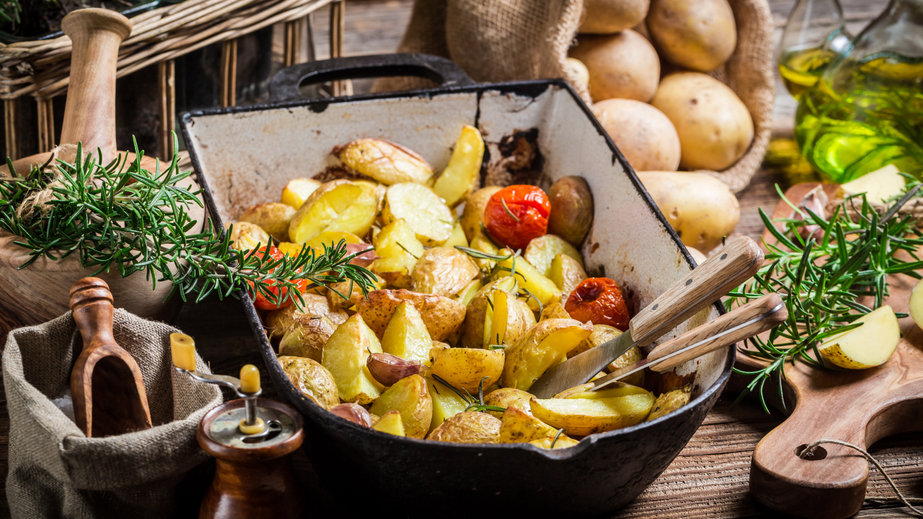


 For most baked potatoes, an oven temperature between 400°F and 425°F provides a useful balance of cooking speed and crisp skin. Temperatures up to 450°F can also work, especially for smaller potatoes, but the exact time depends on the potato’s size, shape, and type.
 The temperature you choose changes the finished potato. High heat generally means a faster cooking time and crispier skin, while low heat generally produces softer skin and a slower bake.
 The type of potato you choose has a major effect on the finished baked potato. Some potatoes bake up light and fluffy, while others remain dense and creamy regardless of oven temperature.
 How you prepare potatoes before they go into the oven matters almost as much as the temperature you choose. Steps such as washing, drying, oiling, and deciding whether to use foil affect the skin’s final texture.
 Cooking time depends on the potato’s size and the oven temperature, but the most reliable way to tell whether a baked potato is done is to check its texture or internal temperature, not just the clock. A few simple tests can help you avoid cutting into an undercooked or overcooked potato.
 A few small habits can turn a great baked potato into a soggy or unevenly cooked one. Most of these mistakes involve trapped moisture, inaccurate timing, or not giving each potato enough room to cook.
 Baked potatoes are generally best cooked at a moderately high oven temperature, around 400–425°F (200–220°C). This temperature is hot enough to crisp the skin while allowing the inside to become soft and fluffy.


