What Temperature Do You Bake a Loaf of Bread? A Practical Guide
Baking bread at the right temperature makes the difference between a doughy loaf and one with a golden crust and soft center. Most bread bakes at 350°F to 475°F, though the ideal oven temperature depends on the type and size of the loaf. A soft sandwich loaf usually needs gentler heat than a crusty artisan boule, and choosing the right range for your recipe helps you avoid guesswork.
Your oven temperature affects more than color. It influences how quickly the dough expands in the first minutes of baking, how the crust forms, and whether the center cooks through without drying out. If the temperature is off, you risk a pale, gummy center or a crust that browns before the middle is done.
This guide breaks down bread baking temperatures for different loaf styles, so you can choose a setting for your bread and check when it is done. Whether you are baking everyday sandwich bread, a sourdough boule, or a batch of dinner rolls, getting the temperature right is essential.
Bread Baking Temperature Chart
Different loaves need different oven temperatures and bake times based on their ingredients, size, and density. Use the chart below as a starting point, and check your recipe for specific guidance.
Oven Temperatures and Typical Bake Times by Bread Type
Lean doughs often bake at higher temperatures than enriched doughs containing fat, sugar, or eggs. Use this chart as a baseline, then adjust based on your recipe, oven, and loaf size.
Bread Type
Oven Temperature
Typical Bake Time
Sandwich bread
350-375°F
30-35 minutes
Whole wheat bread
350-375°F
35-40 minutes
Rye bread
375-400°F
35-45 minutes
Pumpernickel
300-325°F
60-90 minutes
Sourdough bread
450-475°F
20-40 minutes
Brioche
350°F
25-35 minutes
Challah
350-375°F
25-35 minutes
Potato bread
350-375°F
30-40 minutes
Focaccia
425-450°F
20-25 minutes
Banana bread
325-350°F
55-65 minutes
Pumpernickel is often baked at a lower temperature for a longer time because it is dense. Heartier loaves like whole wheat bread and rye bread also benefit from steady, moderate heat so their compact crumb bakes evenly.
Many sourdough loaves bake at high heat to encourage oven spring and develop a thick crust, while yeast breads can bake across a broad range of temperatures depending on the recipe.
Internal Temperatures to Check Before Removing a Loaf
An instant-read thermometer is a reliable way to check whether bread is done. Insert it into the center of the loaf, away from the pan or sides.
Many lean breads, including sourdough, whole wheat bread, and rye bread, are done at about 200-210°F. Enriched loaves such as brioche and challah are often done around 190-200°F, but the ideal temperature depends on the recipe.
Because tender brioche is loaded with butter and eggs, baking it past 200°F can dry out the crumb.
Banana bread and other quick breads are often done at about 200-205°F. Checking the center helps avoid relying on color alone, since oven temperature varies by recipe and doneness depends on the loaf’s interior as well as its appearance.
Choose the Right Heat for the Dough
Different doughs need different oven settings. Soft pan breads generally bake at moderate temperatures, while crusty loaves often need a hot oven for good oven spring and crust development. Small items such as rolls, flatbreads, or focaccia may bake quickly at higher heat.
Moderate Heat for Pan Loaves and Enriched Dough
Set your oven to 350°F to 375°F for many sandwich loaves, dinner rolls, burger buns, and sweet rolls. These breads are intended to have a softer crust and usually do not need the high heat used for crusty artisan loaves.
Everyday sandwich bread thrives in this moderate range, allowing the loaf to bake through completely while keeping the crust thin and sliceable.
Enriched dough with butter, eggs, or sugar can brown quickly. If the oven is too hot, the crust may brown before the center finishes baking.
Croissants are often baked at a higher temperature initially to help create steam and flaky layers, then at a lower temperature to finish baking evenly. Check for doneness with an instant-read thermometer. Pan loaves and rolls are often done around 190°F to 200°F inside, though recipe guidance can vary.
Higher Heat for Crusty Artisan Bread
Artisan bread often needs strong heat to form a thick, crisp crust. Sourdough boules, baguettes, and ciabatta are commonly baked between 425°F and 475°F, depending on the recipe and baking method.
A slender baguette relies on quick, high heat so the interior stays soft while the exterior turns shatteringly crisp. Meanwhile, baking an airy ciabatta or a round sourdough boule at high heat allows moisture to burst into steam before the crust sets.
No-knead bread is often baked in a covered Dutch oven at high heat to trap steam. One method calls for preheating a Dutch oven at 450°F for up to an hour, then baking the loaf covered before removing the lid to brown the crust.
Steam keeps the crust flexible during the early part of baking, allowing the loaf to expand before the crust sets and browns.
Temperatures for Rolls, Flatbreads, and Quick Breads
Small or thin baked goods cook quickly, and some need high heat. Flatbreads and pizza are often baked around 450°F to 500°F, since a hot oven can create blistered spots and a crisp base in a short time.
Baking homemade pizza on a preheated surface delivers rapid oven spring and a beautifully blistered undercarriage. In contrast, soft dinner rolls bake quickly at moderate heat, staying tender and moist throughout.
Similarly, focaccia bakes best at 425°F to 450°F, allowing the olive-oil-coated dough to develop a crisp exterior while keeping the crumb light and airy.
Bagels are commonly baked around 425°F after boiling, which helps set their chewy crust. Quick breads like banana bread or zucchini bread are an exception and generally bake at lower temperatures.
Quick breads often bake at 325°F to 350°F, but the recipe determines the best temperature. Unlike yeast breads, they rely on baking soda or baking powder for leavening. Check for doneness with a toothpick or an instant-read thermometer; the center of many quick breads reaches about 200°F when done.
Check Whether the Center Is Baked
A loaf can look finished on the outside while the center remains underbaked and gummy. Check a few signs to tell whether the inside is fully baked.
Measure the Thickest Part With an Instant-Read Thermometer
An instant-read thermometer is a useful tool for checking doneness. Insert it into the thickest part of the loaf, usually near the center, without touching the pan.
Many lean breads are done between 200°F and 210°F, while enriched doughs made with butter, milk, or eggs are often done around 190°F to 200°F. Temperatures vary by recipe and loaf size.
For soft sandwich bread, aim for an internal reading of 190°F to 200°F. For a crusty sourdough boule, a rustic baguette, or a loaf of ciabatta, the target is often closer to 205°F to 210°F.
Check the temperature a minute or two before the recipe’s suggested bake time ends. This gives you time to continue baking if the center has not reached the recipe’s target temperature.
Use Crust Color and the Thump Test as Supporting Clues
A thermometer gives you the clearest answer, but a few other signs can support what you observe. Crust color is one clue: a deep golden-brown crust often signals a fully baked loaf, while a pale crust may mean it needs more time.
The thump test is another quick check. Tap the bottom of the loaf with your knuckle.
A hollow, drum-like sound usually means the bread is done. A dull or heavy thud may mean the center needs more time in the oven.
Neither test is perfect on its own. A loaf can sound hollow and still have a slightly gummy middle, so checking the crust, firmness, and internal temperature against your recipe’s targets gives you a more reliable answer.
Let the Loaf Cool Before Slicing
Once your loaf reaches the right temperature, resist the urge to cut it right away. Bread continues to set as it cools, and the crumb structure needs time to firm up.
Cutting too soon can make bread seem gummy or underdone, even if it baked correctly. Steam escapes as the loaf cools, and slicing early can disrupt the crumb and make the texture seem dense.
For most loaves, wait at least 20 to 30 minutes before slicing. Larger loaves may need closer to an hour to cool and set.
Preheat and Manage Heat During the Bake
Getting your oven to the right temperature before baking and keeping it steady while your bread bakes matter as much as the recipe itself. Small changes in heat can affect your crust, rise, and how evenly your loaf bakes.
Verify Oven Temperature Before Loading the Dough
Your oven’s dial or digital display may not show the exact temperature. Some home ovens run hotter or cooler than the set temperature, which can affect your bake. Check the size of this variation with an oven thermometer.
An oven thermometer helps you check the actual temperature. Place it on the middle rack and check it once your oven signals it’s ready.
Give your preheated oven extra time beyond what the beep tells you. The air can reach temperature before the oven walls and any stone or pan inside have had time to heat thoroughly.
Allow at least 20 to 30 minutes for preheating, especially when using a baking stone or steel. This matters during the first few minutes of baking, when steady heat supports oven spring.
Use a Baking Stone or Steam for Crusty Loaves
A baking stone stores heat and transfers it to the dough, helping bread develop a crisp, well-browned bottom crust. Place it on the middle or lower rack and preheat it with your oven for at least 30 minutes, or follow the manufacturer’s instructions.
Steam also helps crusty loaves. It delays crust formation during the first few minutes, allowing the dough to expand before the crust hardens.
This early rise is called oven spring, and it’s a key part of good bread baking. You can add steam by placing a pan of hot water on a lower rack, spraying water into the oven, or using a covered pot.
Without enough steam, the crust may set sooner and limit how much the loaf expands.
Reduce Heat or Shield the Crust When Browning Runs Ahead
Sometimes your crust browns faster than the inside of your loaf finishes baking. This can happen with enriched doughs that contain sugar, butter, or eggs, since these ingredients can encourage browning.
If the top is getting too dark before the bake time is up, lower your oven temperature by 25 degrees or loosely cover the loaf with foil. Lowering the temperature may extend the bake time, so continue checking for doneness.
To shield the loaf, place foil loosely over the top once the crust reaches the color you want, then continue baking until the bread is done. Check the internal temperature with a probe thermometer to confirm doneness rather than relying on color alone, since ovens vary and crust color can be misleading.
Adjust for Loaf Size, Pans, and Oven Settings
The pan you choose and how your oven heats can change your bake time. Adjusting for these factors helps you avoid a pale, underbaked center or a burnt crust.
Account for Loaf Shape and Pan Color
Your pan’s shape and material change how heat reaches the dough.
A tall, narrow loaf pan can produce a deeper loaf that may need a longer bake than a wide, shallow pan holding the same amount of dough. Pan dimensions affect dough depth, which can change baking time; use your recipe’s guidance and check for doneness rather than assuming an exact adjustment, according to The Baker’s Calculator.
Pan color matters too. Dark metal pans can brown the crust faster, so check your loaf early and, if needed, lower the oven temperature by about 25°F. Glass and light-colored aluminum pans transfer heat differently, so baking time and browning may vary by recipe.
Adapt Baking Times for Convection and Oven Hot Spots
Convection ovens circulate hot air with a fan, which can speed up baking and promote more even browning than a conventional oven.
If your recipe was written for a conventional oven, follow your oven manufacturer’s guidance or the recipe’s instructions for convection. If neither provides guidance, a common starting point is to reduce the temperature by about 25°F, then check the loaf early.
Many home ovens also have hot spots, areas that run warmer than others because of uneven heat distribution. Uneven browning can help you identify them.
To help even out browning, rotate your loaf pan halfway through baking if your recipe allows. Turn it 180 degrees so the side facing the back of the oven now faces the front. This can promote more even browning, though it may not make the loaf bake at exactly the same rate on all sides.
Troubleshoot Pale Crusts and Doughy Centers
Bread problems can result from a mismatch between oven temperature, baking time, and dough condition. Common fixes include adjusting the heat, checking internal temperature, and changing how you steam or shape your loaf.
When the Crust Browns Before the Middle Is Done
If your crust turns dark but the inside is still underbaked, your oven may be too hot for the size or type of loaf. Large or dense loaves often need a lower, longer bake so heat can reach the center before the crust gets too dark.
Try dropping your oven temperature by 25°F and baking longer, checking frequently for doneness. You can also tent the loaf with foil once it reaches your desired crust color to shield the surface while the inside finishes baking.
Check the internal temperature as one indicator of doneness. Many lean loaves finish baking around 200-210°F, while some enriched breads may be done at a lower temperature; follow your recipe’s guidance. A thermometer can help identify an underbaked center.
When the Loaf Stays Pale or Spreads Instead of Rising
A pale, flat loaf often points to low oven heat, weak steam, or dough that lacks structure. Browning reactions depend on factors including heat, surface moisture, and the dough’s ingredients, so a drop in oven temperature of just 20°F can leave a loaf looking pale and underbaked.
Check your oven with a separate thermometer, since built-in dials may be inaccurate. Make sure your steaming method creates humidity early in the bake, and confirm your dough contains ingredients that support browning, such as sugars.
If your loaf also spreads instead of holding its shape, weak gluten development or overproofing may be the cause, rather than oven temperature alone.
FAQ: What Temperature Do You Bake a Loaf of Bread?
Most loaves of bread are baked at 350°F to 450°F (175°C to 230°C), depending on the type of bread and recipe. A standard sandwich loaf is often baked around 350°F to 375°F (175°C to 190°C), while artisan breads are commonly baked at higher temperatures.
What Temperature Is Best for Homemade Bread?
For a typical homemade loaf, 375°F to 425°F (190°C to 220°C) is a useful general range. The ideal temperature depends on the dough, loaf size, and desired crust.
What Temperature Should Bread Be When It Is Done?
Many yeast breads are fully baked when the center reaches approximately 190°F to 210°F (88°C to 99°C). An instant-read thermometer inserted into the center is more reliable than judging doneness by crust color alone.
Should You Bake Bread at 350°F or 400°F?
Both temperatures can work, but they produce different results. 350°F is suitable for many softer sandwich-style loaves, while 400°F can produce stronger browning and a more developed crust.
Does Bread Bake Better With the Oven Preheated?
Yes. Preheating the oven allows the dough to enter a properly heated environment immediately, which helps with oven spring, crust development, and even baking. Always preheat to the temperature specified by your recipe.
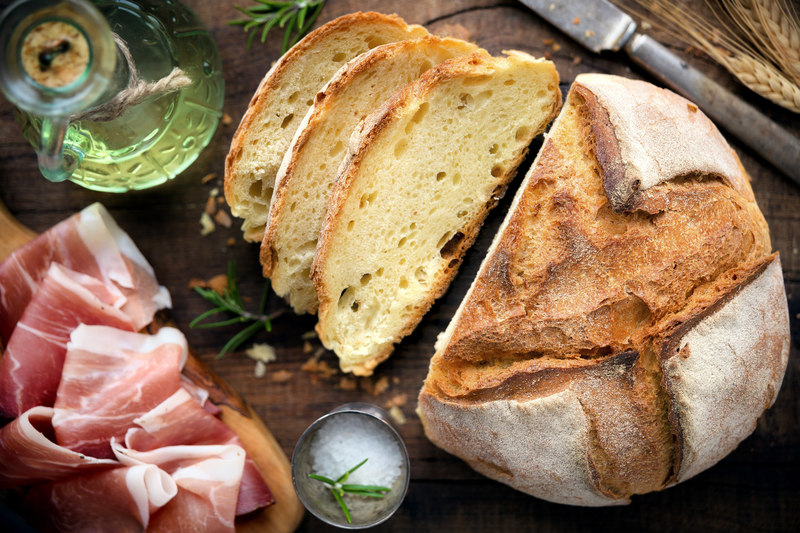


 Different loaves need different oven temperatures and bake times based on their ingredients, size, and density. Use the chart below as a starting point, and check your recipe for specific guidance.
 Different doughs need different oven settings. Soft pan breads generally bake at moderate temperatures, while crusty loaves often need a hot oven for good oven spring and crust development. Small items such as rolls, flatbreads, or focaccia may bake quickly at higher heat.
 A loaf can look finished on the outside while the center remains underbaked and gummy. Check a few signs to tell whether the inside is fully baked.
 Getting your oven to the right temperature before baking and keeping it steady while your bread bakes matter as much as the recipe itself. Small changes in heat can affect your crust, rise, and how evenly your loaf bakes.
 The pan you choose and how your oven heats can change your bake time. Adjusting for these factors helps you avoid a pale, underbaked center or a burnt crust.
 Most loaves of bread are baked at 350°F to 450°F (175°C to 230°C), depending on the type of bread and recipe. A standard sandwich loaf is often baked around 350°F to 375°F (175°C to 190°C), while artisan breads are commonly baked at higher temperatures.


